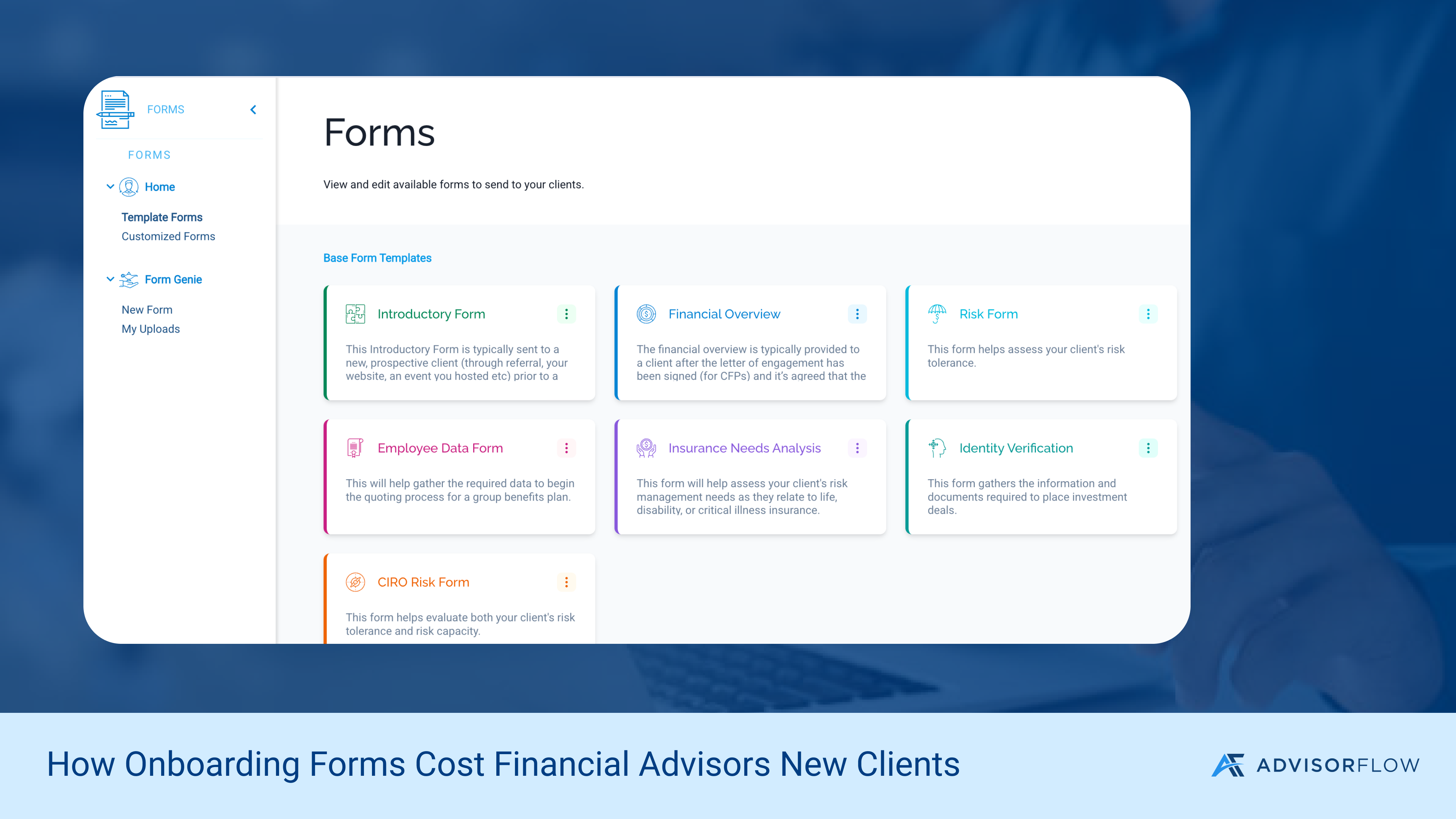
You only get one chance to make a first impression. For many financial advisors, that first impression is a form.
When forms feel generic, repetitive, or disconnected from the onboarding process, clients disengage quickly. This often happens when questionnaires are sent as standalone PDFs, repeated across multiple touchpoints, or lack context around why questions are being asked.
The good news: a few intentional changes to how you design and deliver forms can dramatically improve completion rates, the quality of information you gather, and the overall client experience from day one.
Key Takeaways
- Well-designed form workflows improve client engagement and trust
- Language and framing influence how honestly and fully clients respond
- Repeating questions across forms creates frustration and erodes trust
- Digital tools simplify form creation, delivery, and follow-up
- Strong form experiences lead to better insights and stronger relationships
Best Practice 1: Tailor Your Questions to Your Market Niche
Instead of trying to appeal to everyone, focus on the clients you serve best. Tailored forms allow you to address the specific concerns, values, and goals of a defined group, making the experience feel relevant rather than generic.
To design an effective questionnaire, think about your clients' world: their ambitions, fears, and day-to-day priorities. As Jeff Thorsteinson notes on Advisor Edge, advisors should understand their niche's issues as if they were a member of that niche themselves.
In practice, this means:
- If you work with families, ask about long-term planning, dependents, and shared goals.
- If you work with business owners, focus on cash flow, succession planning, and growth.
- If you serve pre-retirees, center questions around timeline, income needs, and lifestyle goals.
The guiding question should always be: How does this information help me give better advice?
Best Practice 2: Use Language That Encourages Honest Responses
Even with the same client niche, individuals bring different experiences, emotional relationships with money, and personal priorities. A one-size-fits-all approach to wording, even within a well-defined segment, can lead to vague or guarded answers.
The goal isn’t to customize every form from scratch for every client. That would be unsustainable. Instead, it’s about building a small set of thoughtfully worded variations or optional question paths that you can deploy based on what you already know about the client going in.
Here are some practical DO’s and DON’Ts:
DO
- Use plain, conversational language. Skip the jargon.
- Frame sensitive questions with context so they feel like guidance, not an interrogation.
- Offer response options that allow for nuance, not just yes or no.
- Normalize uncertainty so clients feel comfortable being honest.
DON’T
- Use leading questions that steer clients toward a particular answer.
- Ask multiple things in one question. It confuses clients and muddies the data.
- Use clinical or legalistic phrasing for questions that are really about emotions and values.
Best Practice 3: Avoid Repeating Questions Across Forms
One of the fastest ways to frustrate clients is asking for the same information multiple times. Repetition often occurs when intake forms, onboarding forms, and follow-up questionnaires are disconnected or managed manually across different systems.
When clients are asked to re-enter information they’ve already provided, it signals inefficiency and can quietly reduce trust early in the relationship.
Tip: Centralize Your Data
Use a platform that pre-fills client data based on forms they have already completed. This reduces friction, saves time, and ensures your forms feel like part of a cohesive experience rather than a series of disconnected requests.
Tip: Make Forms Easy to Complete on Any Device
Clients are more likely to finish forms when they are intuitive, concise, and convenient. Digital forms that can be completed on any device and updated over time remove unnecessary barriers and show clients that you respect their time.
The Impact of Getting Forms Right
When forms are designed and delivered with intention, advisors consistently see:
- Clearer insight into client goals, preferences, and priorities.
- Higher completion rates and better engagement.
- Reduced administrative friction for both clients and advisors.
- Stronger, more trusting relationships from the very first interaction.
Mobile‑friendly digital forms are particularly important: 82% of users now expect to complete essential forms on their mobile devices, making accessible, responsive forms key to engagement and completion (Tinyform, 2025).
Digital surveys allow advisors to create consistent, branded experiences that feel thoughtful rather than repetitive. The result is better data, smoother workflows, and more meaningful client conversations.
Visit AdvisorFlow to learn more and start creating digital forms that elevate your client experience today.